
FIVE: March 7, 2026
VINCE ALETTI'S PHOTOBOOK OF THE MONTH CLUB / POW: JOSH EDGOOSE / THE LIST (OF THOSE YOU SHOULD KNOW) / INTERVIEW WITH SANDI HABER FIFIELD / RETROSPECTIVE:SALLY GALL / OLIVER WASOW'S NATIONAL PORTRAIT.

VINCE ALETTI’S PHOTO BOOK OF THE MONTH CLUB.

Jeff Mermelstein has taken several of the most memorable photographs of the urban street, including the woman holding a wad of dollars in her teeth, the man chomping down on a big, fat paperback, and a burning work boot, scorched and steaming on the sidewalk. He continues to make great, insane, only-in-New-York pictures, but his new book, What If Jeff Were a Butterfly? (Void), wanders off in a different direction.
It’s not exactly a memoir, but it’s interrupted here and there for scrapbook-like arrangements of family photos and it includes scrawled memo-pad pages full of notes to self: “It seems that photography has become my religion” and “Sometimes I feel like my organizational skills are like a hairball out of a cat’s mouth.” Other notes recall Diane Arbus’s lists of possible projects: “plastic, drugs, sex, fitness, weddings, music, Christmas, kids.” He follows through on another idea, “mahjong,” with countless photos of big-hair ladies sitting around tables full of jumbled tiles. Like Martin Parr, Mermelstein is drawn to garish colors, flamboyant characters, and random oddities: a dead whale on a flatbed trailer, a bee in a Coke bottle, an elephant using its trunk to get a guard’s attention.
But if his book has a theme, it’s flowers: page after page of petals, pistols, and stamens, both fresh and wilted, in startling, butterfly-eye close-up. What starts out as cheery becomes manic—a celebration veering a bit out of control. Mermelstein’s butterfly is also a bee; his book buzzes with eccentricity and wit.
Jeff Mermelstein “What if Jeff Were a Butterfly” (Void), 2026.
PORTFOLIO OF THE WEEK: JOSH EDGOOSE.


“Hello, I’m Josh Edgoose. I’m a photographer from London. I’ve been taking pictures around the UK for the best part of 10 to 15 years. I like focusing on interactions between people, portraits of strangers, and honing in on this sense of humour in everyday life.
My work is heavily influenced by Martin Parr, focusing on little events and quirky little things going on around the UK, and trying to approach them with a strong sense of colour.
My work is rooted in this love of film photography, but I can’t afford to shoot film, so I shoot digitally and do a lot of work in post. I’ve been influenced by movies from the 90s and generally I want people to look at my photographs and have a positive reaction, because there’s enough negativity on the internet as it is.”
Josh Edgoose has had his work appear in BJP, The Guardian and I-d, and a book of his photographs ‘Ten Miles West’ was published by Senata Books in 2023. He is represented by At Trayler in London.
THE LIST. (OF THOSE YOU SHOULD KNOW)
THIS WEEK’S RECKONING OF THOSE WHO ARE ON OUR MIND: A GLOBAL GATHERING OF THE INFLUENTIAL, THE CLEVER, THE SILENT, THE TRULY ORIGINAL, THE TENACIOUS.
Alice Beck-Odette
INTERVIEW WITH SANDI HABER FIFIELD NOVEMBER 2025.

STEPHEN: From the earliest work, with the exception of one group, you have been engaged with disparate photographs joined together, and that proximity forming a narrative; a train of thought. Could we start with that, and your interest in this dynamic?
SANDI: When I began as a photographer in the late 70s I removed the interior mechanism of the camera so that one image could bleed into the next. Since then, I have produced many bodies of work with combined imagery. As a student at that time, I was most interested in photographers like Robert Flick, Robert Heinecken, and Thomas Barrow who experimented and moved outside of the traditional frame. The concept of combining imagery seems integral to perception itself.
The artist Ann Hamilton said, “Everything is about two things coming together.” As we write, you and I are experiencing that very notion; finger to key, email through cyberspace, you to me, idea to idea…. we all experience the world with constant reference to something else. The accumulation of perceptions and how we sort and assemble disparate imagery is endlessly interesting to me. The camera is my means of gathering from the world, and then the studio is where I make sense of it.
John Berger in About Looking discusses a “radial” approach to photography, suggesting that experience and memory are always shifting, they are not fixed points in time. And of course, the Cubists in the early 1900s moved away from a single perspective and thus created visual fragmentation or different views of the same picture frame. My work reflects the ways in which we choose disparate bits of reality and organize them into a coherent and harmonious whole, while maintaining the sensation of collision and disruption that is the very nature of modern experience.
And there is a translucency to much of the work throughout that suggests a foreground and background—-a dimensional depth; is this another kind of combination, of conversation?
When the works became sculptural it was natural for me to examine the impact of spatial shifts and the sensory elements of vision. Transparency of materials is part of that juxtaposition – back and forth, internal, external. The interplay of layered space adds depth to the geometry and builds a natural motion between light and shadow. The layers increase the volume and add more geometric space than the making implied. For me, there is no such thing as a still or fixed picture; a piece may exist on the wall as an object, but it moves and shifts as the viewer sees it from afar or moves to a closer examination. There is a filmic quality to looking. I want the viewer’s eye to constantly shift, making it an experience that fosters connections between fragments or parts.
This is interesting. With your use of the word filmic, I am thus thinking of conventional photographs as being like theater—one is fixed in a point of view. And, of course, the relationship is to sculpture (and your reference to cubism) and that it shifts with the slightest change of viewing position.
Yes, exactly. The word theatre in photography reminds me of an assignment I had in graduate school: Find a busy location---a Manhattan street corner or Jones Beach on a hot day---and stay in the same location for an hour, taking pictures to see how the frame changes. Where does one’s eye center itself and where does it roam – what makes the most compelling image? In this instance the photographer remains stationary and allows the “stage” to unfold. In my series The Thing in Front of You, the filmic quality comes from the horizontal format and connecting images that are laid next to each other - one’s eyes go back and forth, noticing the associations as well as the empty spaces. In the new sculptural work, the movement comes from the layering and light sources; there is an implied and actual visual depth and movement.
I’ve long had the opinion that photography, as a whole, has been constantly enriched by absorbing sensibilities and procedures that are extrinsic and that its flexibility as a medium is its great strength. So: conventional wisdom might suggest that you should ‘be a sculptor’ but I think it might be more challenging and invigorating for you to, as you are doing, bring sculptural characteristics to the photograph. Is this right?
The choice of materials is a fluid process and wholly dependent upon what I’m trying to say. I’m a huge fan of contemporary sculptors like Jessica Stockholder, Arlene Shechet, and Richard Tuttle but I can’t imagine saying that I am a sculptor! Photography is my home base and where I’m most comfortable. Inevitably, I start from a photographic image and take my cues from there. And yes, photography is indeed malleable in that we can print on a broad array of materials and the photographic image can be drastically altered. In recent years I’ve expanded with a variety of interventions like drawing, vellum paper, or multiple collaged images, and today, with plexiglass and wood. I’ve also explored photo-based sculpture in outdoor settings and in those works the photographs and the sculptural materials have been a response to the setting, literally fitting into the landscape.
In spite of the additional materials, I’m still interested in the photograph - what is taken from the world – whether it be “abstract” or “representational”. With many of these pieces, I’m exploring moments of uncertainty and the question of what is real. In our era of simulation, can we tell the difference between true and false, and does it matter? Specifically, a few pieces highlight wood, the actual and the photographed. I’m interested in trompe l’oeil (going back to the Cubists again) and the idea of illusion, or the true nature of reality. The concept of construction is also activated with several pieces, both the literal construction of the work itself - hand cutting plexiglass and wood – as well as the photographing of construction sites.
I think I’ve veered off from your original question but I’m always excited to start with a photographic image and see what it tells me to do next.
Is the work subversive? Or perhaps mischievous? And also: is your intention to make something that is harmonious? That sort of resolves the parts?
I assume you mean subversive as a conscious intent regarding the question of what the photograph is. I love the malleability of the photograph but when I begin a piece it is not with an intention to turn the medium on its head. My materials are my laboratory and as they coalesce, the alchemy happens. I work hard to push concepts forward but I’m not making a statement about traditional systems - those have proven to be broken and reexamined long before my work came along. But it comes up in my thinking, especially in a world of AI and the question of what is real and what is simulated. The word mischievous may be apt, there is definite satisfaction when one discovers and is surprised that the wood is sometimes a photograph and other times actual wood, or a flat red surface, for example, is not silk screened but may come from a photograph of a red car or red curtain. The harmony is typically formal, working with the parts to become whole or finished, but that doesn’t mean it negates collision or dissonance. The works are very much about making sense of the natural and the manmade in our modern era or fostering connections between random fragments. At the same time, despite the formal harmony I think the work also demonstrates the impossibility of complete synthesis by leaving jagged disconnects. The pieces are labor intensive in their construction - they are not fed into a machine. A scroll saw or a band saw is used to cut the plexiglass and the hardware is chosen to “harmoniously” connect the parts, and the drawing is by hand. Parallel to that, the materials are vernacular ones frequently used on construction sites and I am sometimes on such sites to shoot.
One last thing. In addition to the inventiveness of the work, I appreciate its humor, and in particular the newer works that you identify as ‘photo based sculpture’. Is this appropriate to be amused?
Hmmm, I have never thought of my work as humorous and it is not generated from such a perspective, but if you mean humor in terms of the questions within the work, the surprise of new spaces, or sometimes as a vehicle to disarm the viewer, you could use that description. Perhaps in the new work you are referring to the panoply of color which at times verges on acid rainbow. One is reminded of The Memphis Group whose designs for postmodern furniture and asymmetrical shapes were defined by bright and clashing colors and, like them, my materials – plexiglass, wood, string, graphite – are quite ordinary. My approach to color is haptic and refers to Goethe’s theories of the psychological impact of color, its gestalt or perception, if you will. Joseph Albers said, “We do not see colors as they are. Our perception of color is influenced by what surrounds it.” I too believe that context alters all perception which brings us back to my response to your first question.


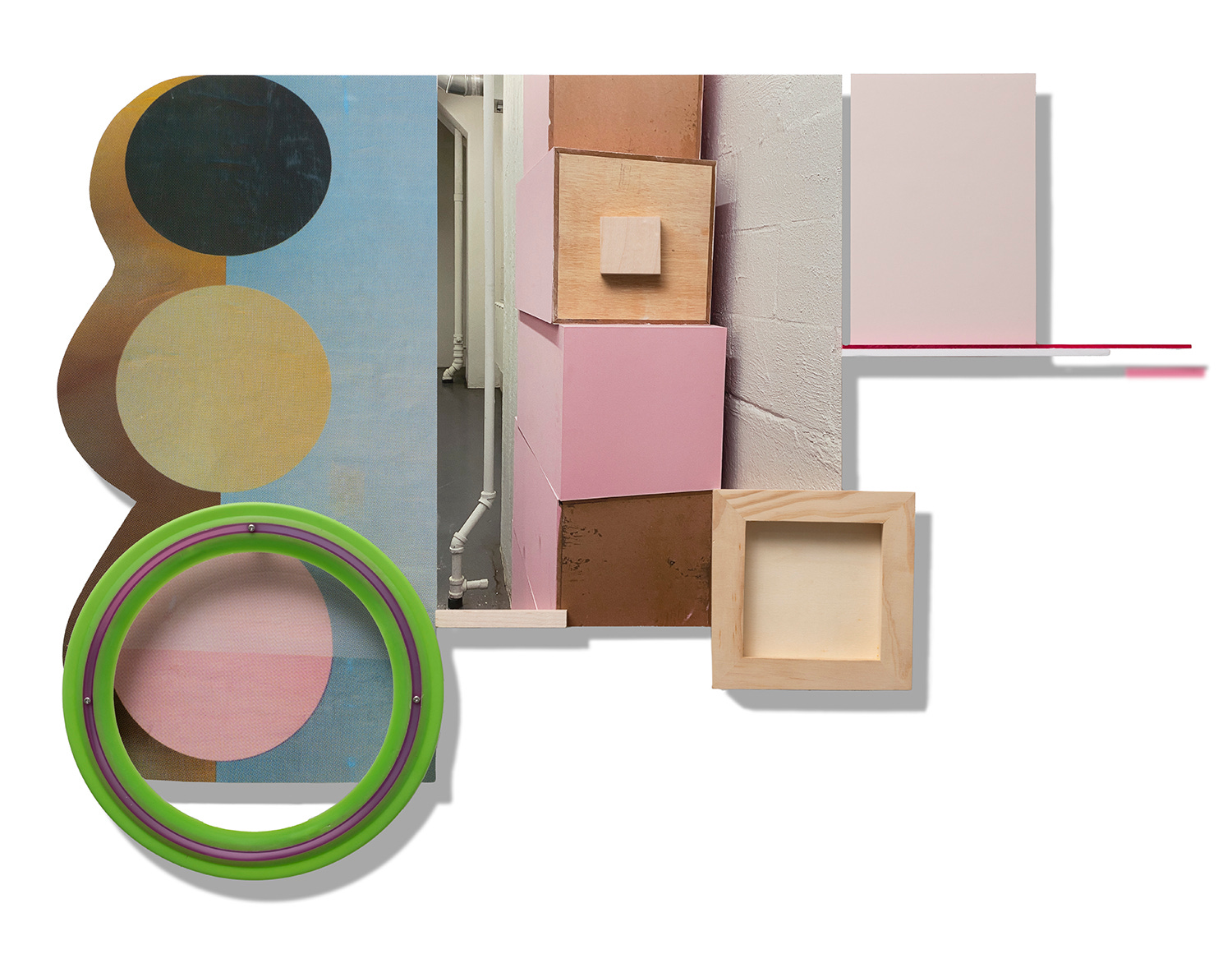
Sandi Haber Fifield has work in the collections of The Museum of Modern Art, New York, The George Eastman Museum in Rochester, The Brooklyn Museum and The LA County Museum, among many others. She is represented by the Yancey Richardson Gallery in New York.
OLIVER WASOW’S ‘NATIONAL PORTRAIT’ (IT’S A FRESH WIND THAT BLOWS AGAINST THE EMPIRE).

RETROSPECTIVE.
A PHOTOGRAPHER SHARES THE ONE IMAGE FROM PAST WORK THAT, IN RETROSPECT, CHANGED EVERYTHING. CLEAVED PAST FROM PRESENT; THE TIPPING POINT THAT BECAME THEIR FUTURE.

SALLY GALL “Canoe” 1990.
The natural world has always been the locus of my work, the animating spirit of my photographic explorations. I am interested in how humans move through nature, interact with nature, and shape nature. To this end, I have photographed gardens, cultivated fields, hiking trails, plane contrails, among other things, as “evidence” of humanity. In 1990, with the creation of Canoe, I felt my intentions coalesce and I found my path forward.
Canoe is a photograph of a birch bark canoe resting on the edge of a pond, an object made to transport people and things, created out of an element of the landscape. The canoe is of the landscape and simultaneously a separate entity. It began as an upright tree and became a horizontal body-like vessel. Someone cut the tree down, and someone transformed the tree into the canoe that lives on in my photograph.
Canoe pointed a path forward to me. And including the viewer was significant: as I offer them a path and the opportunity to climb into the canoe and journey into the unknown.
I photograph with an ever-deepening appreciation for how the earth shapes us, even as we shape it, with our passage.
New York, February 2026.
Sally Gall has published three books of photographs, most recently Heavenly Creatures by Powerhouse Books. Her work is in numerous public collections and she is represented by Winston-Wachter Fine Art in New York.